 (alpha)
- Artists & Events
- Artists & Events
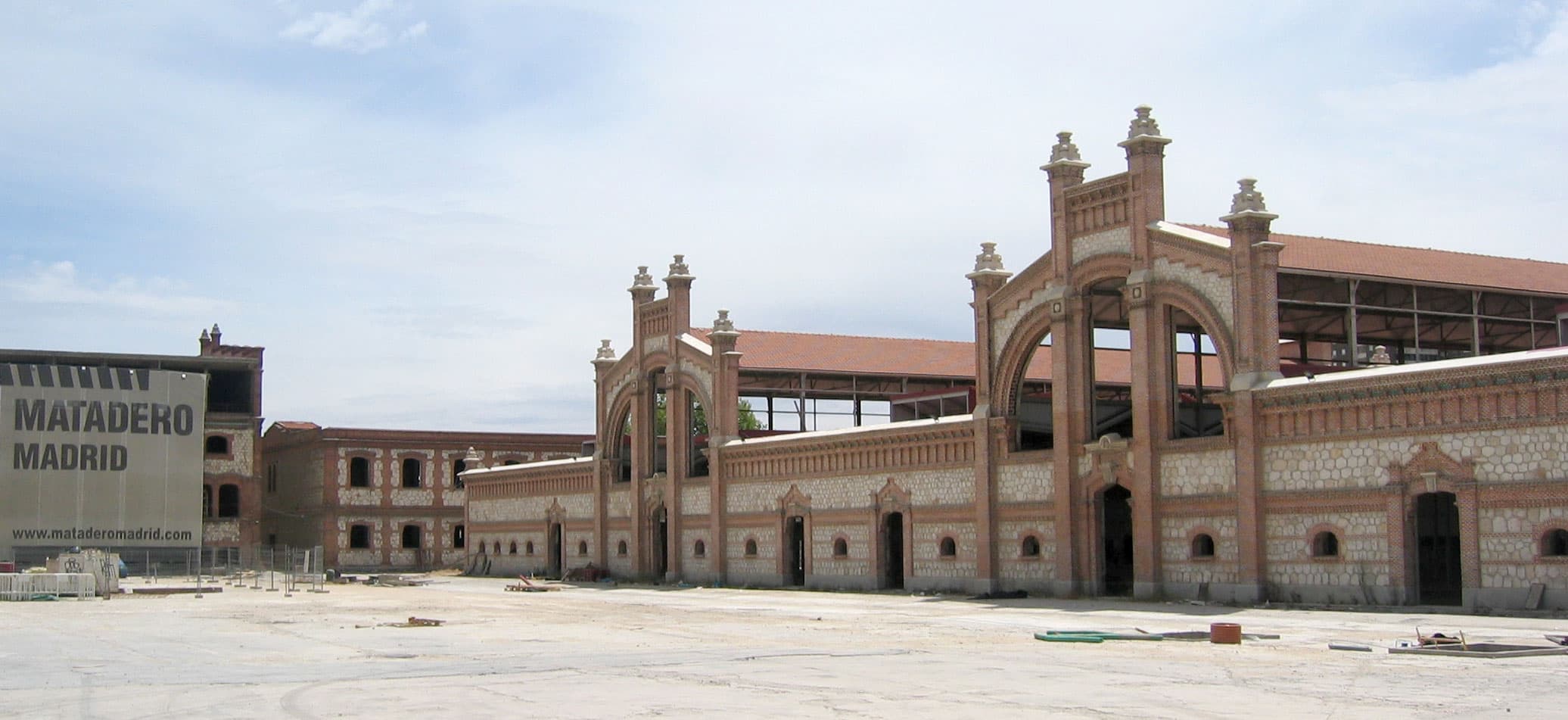
Matadero Madrid is one of Europe's most ambitious examples of industrial heritage repurposed for contemporary culture. Occupying the former municipal slaughterhouse and livestock market of Madrid — a complex of 33 neo-Mudéjar brick buildings constructed between 1908 and 1928 on the banks of the Manzanares River — the cultural centre spans roughly 165,000 square metres and operates across more than a dozen distinct spaces, each with its own programming identity.
The conversion began in 2006 under the city's Urban Revitalization Plan and has developed incrementally, with different buildings coming online over time and each being adapted for a specific cultural use: a contemporary circus space, a design hub, a theatre for emerging companies, a film archive and screening room, a large nave for concerts and installations, a children's arts laboratory, and multiple gallery spaces. No single visit covers all of it.
What Matadero shares with its counterparts in Lisbon or London is the refusal to sanitise its industrial origins. The brick vaulting, the iron doors, the loading docks, and the vast scale of the original buildings have been preserved and form the character of the space. Programming spans theatre, dance, contemporary music, literature, visual art, architecture, design, and digital culture, with a particular emphasis on emerging and experimental practice across all disciplines.
cultural-centre, arts-complex, industrial-heritage, multidisciplinary, live-music
converted industrial, Manzanares, Madrid, multidisciplinary arts, theatre, concerts, exhibitions, free entry, outdoor space, architecture
Matadero sits on the Paseo de la Chopera in the Arganzuela district, immediately south of the Madrid Río park and alongside the Manzanares River. The surrounding area has undergone significant transformation since the construction of the Madrid Río park following the burial of the M-30 motorway underground — what was once an industrial and transport corridor is now an extended riverside park, with Matadero as its primary cultural anchor.
The site is substantial enough to feel like entering a separate neighbourhood within the city. The main entrance on Paseo de la Chopera opens onto a large internal plaza from which the individual buildings of the complex radiate outward.
Matadero is generally open Tuesday through Sunday, with varying hours depending on the specific building and programme. The outdoor spaces and plazas are freely accessible at all times. Most gallery spaces and exhibitions are free or low-cost. Ticketed events such as concerts, theatre productions, and film screenings have individual pricing, typically in the range of €5 to €18.
The programme is published seasonally and covers a dense calendar of events across all disciplines simultaneously. Some buildings operate independently with their own ticketing and opening hours, while the central plaza and outdoor areas are consistently animated throughout the week.
The site operates as a cluster of distinct but interconnected venues rather than a single building. The Nave 16, the largest space, is used for concerts, large-scale installations, and multidisciplinary productions, with capacity for several thousand people. The Intermediae space focuses on participatory and co-production projects. The Cineteca runs an independent cinema programme. The Central de Diseño handles design and architecture exhibitions.
Moving through Matadero requires time and curiosity rather than a fixed itinerary. A typical visit might involve an exhibition in one space, a drink in the courtyard, and an encounter with a workshop or rehearsal in an adjacent building. This quality — of the venue as a live and active place rather than a closed container — is central to what Matadero is.
Paseo de la Chopera, 14, 28045 Madrid
Madrid, Spain
No events scheduled at this time for this venue.